
Advanced EMT Education Program
Email training@brsvt.org with questions
AEMT Education Program Applications are closed - full enrollment
Please be sure to read this entire page prior to applying.
About AEMTs
The Advanced EMT (AEMT) is an EMS professional with an expanded scope of practice over EMTs. AEMTs provide care in volunteer or career roles. To qualify for AEMT, you must be a current NREMT or state EMT.
This education program meets the requirements of states that accept National Registry AEMT (NRAEMT) certification and license AEMTs. Not all states have AEMTs or will accept NRAEMT alone for certification. If you are not in a NREMT state, you must check with the state EMS office where you intend to practice to determine if NRAEMT is acceptable for license or certification.
Our course uses a flipped classroom model (mostly online, independent study for non-lab classwork). The in-person class time dedicated skills, scenarios, and simulations.
We know our course is NOT accepted by NY State for AEMT reciprocity due to the flipped classroom model. Do not apply if you intend on applying to practice as an AEMT in NY.
Class Overview
There are 3 parts to this program:
Online Didactic: Consists of assigned self-study and homework. Homework is due every Monday by 23:59 hours.
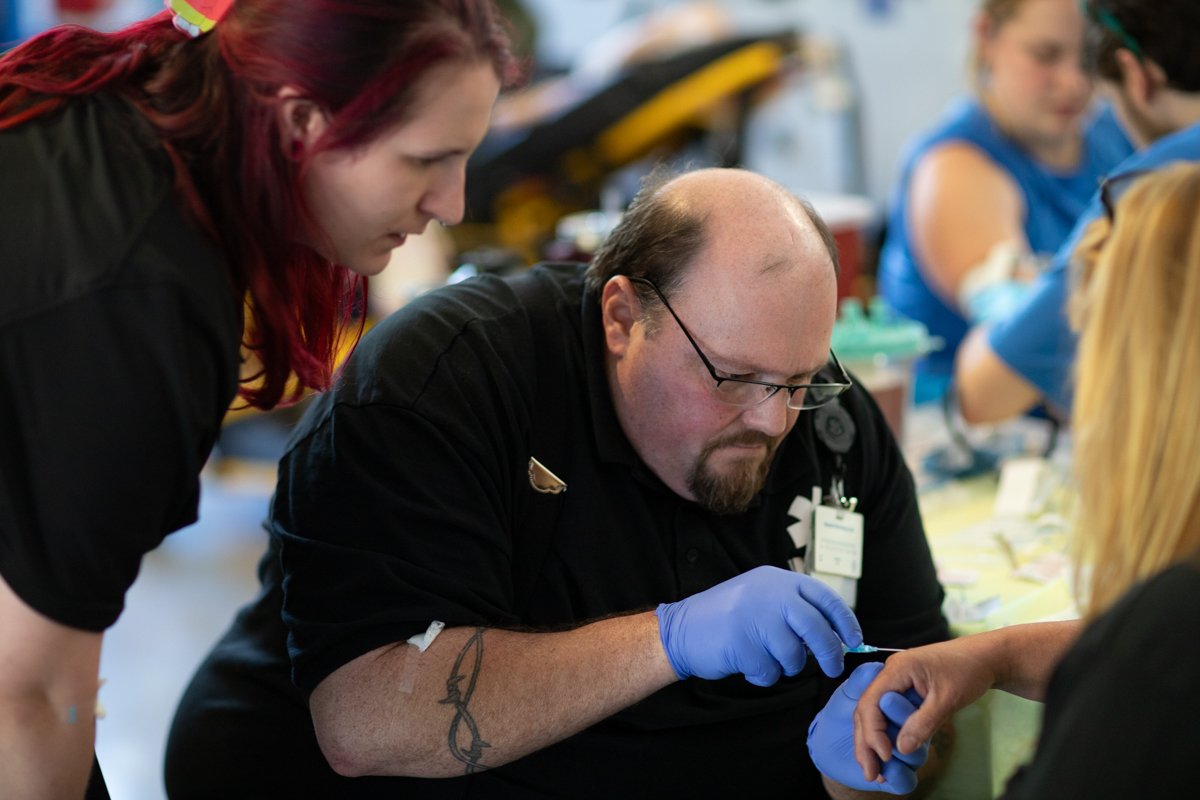
Lab Days: In-person class days with skill practice & evaluation, scenario, or simulation practice & performance evaluations. This class meets for lab every Tuesday from May 19 - Jul 14 from 08:00-15:00.
Patient Care Experience: This time is scheduled via the course coordinator or their designee and has 3 parts:
Clinical Experience is 36+ hours in the Southwestern Vermont Medical Center emergency department.
Field Experience is 48+ hours on a VT ALS ambulance with an ALS preceptor as a third crew member.
Field Capstone Experience is 24+ hours, no maximum. The student must successfully manage 5+ ALS patients as evaluated by their ALS preceptor.
VT EMS Course #: 26-12-AEMT-124 - Primary EMS Lab Skills Instructor: Katie Fox - Senior Instructor / Coordinator: Bill Camarda, VT EMS ID 103047
Course Fee
$900* which covers e-book with learning management system, AEMT study app, AEMT class shirt, and course supplies.
*Normally the fee for this course is $1,900 per student. It is being offered for $900 to cover educational materials, supplies, and other disposables used during the course with the remainder of the fee (instructor costs) covered by a SAMHSA Rural EMS Training Grant. If the federal government changes any aspects of the grant, fails to fund, or cancels the grant prior to the start of the class, students must pay the full $1,900 course fee.
Additional costs may include:
NRAEMT Certification exam fees, see NREMT website for current fee (VT EMS personnel are eligible for exam fee coverage by VT EMS).
Background check fees, if required by the clinical site.
Uniform or straight leg pants, boots/closed toe shoes, appropriate department/EMS outerwear, analog watch, etc.
Any additional study aids, equipment, etc, the student chooses to purchase on their own.
Medical screening & immunization costs.
Refund Policy
A 50% refund ($450.00) is available until the first day of the course. Written notice via email must be sent to the instructor/coordinator.
The course fee is not transferable.
Enrollment Process:
File the online course application (closed)
Send your 2 letters of recommendation, current EMT card(s), current BLS CPR card, FEMA IS certificates, VT Mandatory Reporter, Medical Screening Form, and Immunization Form to training@brsvt.org.
Take the FISDAP Entrance Assessment ($40 cost).
This is required and students must achieve a score of 60% or higher in all knowledge areas to qualify for enrollment (Math, Biology, Reading, EMT-level knowledge). 2 attempts at this pre-enrollment assessment are permitted. Assessments are proctored at Bennington Rescue Mon-Fri 7:30-14:30. Affective scores are considered along with the entire application. Here are sample questions.
When offered a seat, students must pay their course fee within 24 hours or the seat is provided to the next qualified student.
Ensure all prerequisites are ready for submission in the online classroom for the first week of the class.
Student Requirements
Prerequisites
18 years of age by the time of course start.
Current, valid EMT with either NREMT certification and/or state EMT.
BLS Provider CPR (AHA or ARC) - NOTE: Certifications from National CPR, ACLS Medical Training, etc. often advertised as “fully online” without a skills component are not accepted.
FEMA IS- 5 (or equivalent EMS HazMat Awareness or above), 100, 200, & 700. The links take you to the courses if you do not have it already.
1 year of active experience as a licensed/certified EMT preferred.
2 or more letters of recommendation(s) must be from:
AEMT or paramedic (preferred) the student currently practices with,
Direct supervisor, training officer, or head of service, or
Agency medical director.
Clear criminal & protected registry history. Contact the state EMS office and NREMT if you need to discuss your history prior to submitting an application for this program.
Physical health requirements, on the Bennington Rescue medical screening form completed and submitted by the start of the course:
Medical screening and attestation from your healthcare provider that you are healthy enough to participate in the AEMTs progra,. This includes:
wearing constricting PPE such as a disposable respirator (N95 mask).
being able to lift over 50 pounds,
ability to kneel, squat, bend, get up off the floor independently, etc.
Proof of current immunizations or titers to prove immunity on the Bennington Rescue immunization form prior to the first day of class which includes TB testing (2-step PPD - skin test done twice or Quantiferon/T-spot testing), MMR, varicella, influenza, Tdap, Hepatitis B.
Do NOT send other immunization and health records. The form provided in the link above MUST be submitted, no exceptions.
Proof of current fit test, respirator used, and you must bring your own N95 masks for field time, clinical, and capstone experiences.
Technology Requirements:
Computer - A computer is required to complete coursework. A tablet may work if you have a keyboard. We recommend you bring your devices for exam days, we do have up some Chromebooks available for use in the classroom for exams.
Reliable internet connection is required.
You must be able to sign, print, and scan online PDF documents.
You must be comfortable with online learning and technology to participate in this course. If you find yourself saying things like “technology and I don’t get along,” “I learn better in person,” etc. then this is not the program for you.
The function of your devices is your responsibility.
Other Course Requirements:
Math Skills - Successful students in this program must master these math skills. Previous preparation and training in these areas are critical for academic success in this program.
Use of military time
Fractions, decimals, and percentages
Ratios and proportions
Reading gauges
Metric to standard conversion
Basic math (addition, subtraction, multiplication, division)
Basic algebra (determining concentrations, dosages, etc.)
Uniform:
Students must wear the AEMT class shirt for in-person class sessions. The class shirt is provided as part of the course fee.
Black, dark blue, or khaki colors are acceptable. Denim/jeans, leggings, shorts, etc. are not acceptable. Uniform-style pants are not provided and are the responsibility of the student.
Sturdy footwear, such as black uniform boots, are strongly recommended but not required. Open-toe footwear is prohibited in the classroom and clinical experience.
We provide gloves, hand sanitizer, handwashing facilities, and disinfectant wipes for in-person class sessions.
A watch is required to take a pulse, count respiratory rates, calculate IV drip rates, etc. Smart watches are not the best option. An analog watch with second hand or digital with timer/stopwatch is highly recommended.
Students must achieve a course grade of 80 or higher PLUS passing scores on the unit exams, written final, & simulation final exams to graduate. The course grading rubric is based off of 100 total points:
20 points: FISDAP AEMT Unit Exams - a score ≥60% is required with each unit exam to continue with the course
20 points: homework & quizzes online
20 points: attendance - all classes must be attended
20 points: affective (attitude toward the course, instructors, patients, preceptors, etc.; treating class time with respect; taking initiative, etc.)
20 points: final written exam - FISDAP Comprehensive AEMT Exam - a score ≥65% is required to pass the course
Frequently Asked Questions:
Q: Do you offer payment plans or financial aid?
Answer: Sort of. Bennington Rescue does not directly provide any payment plans or financial aid. Potential students may be eligible for local, regional, or other scholarship or grant programs. Bennington Rescue is a participating education provider for the VSAC Advancement Grant for Vermont residents.
Q: I already have obligations the same time as some class sessions, can I be excused and make up the work?
Answer: No. Do not sign up for the program if you know you already have a conflict. All class sessions must be attended on time for the entire time. Any time absent results in a deduction from the course grade. Missing class session(s) results in dismissal from the program. You may not be on call, actively working, etc. during class sessions.
Q: Does completing the education program certify me as an AEMT?
Answer: No, after course completion you must then successfully pass the NRAEMT examination to obtain NRAEMT certification. All NRAEMT cognitive testing must occur in-person at a PearsonVue testing center, click on this link to find out more.
Q: Are ADA accommodations available for learning disabilities?
Answer: Accommodations are addressed on a case-by-case basis. NREMT, the certifying body, typically only makes accommodations for the length of cognitive (computer/written) testing - see their information here. To support cognitive accommodations, documentation must be submitted. Contact the instructor/coordinator to discuss prior to enrolling in the course. Psychomotor accommodations are not available, students must be able to physically perform all skills.
Q: May I ride at my ambulance service or do time at my local ED?
Answer: It depends.
AEMT Students are not permitted to perform any invasive AEMT skills outside of a Bennington Rescue authorized student experience.
All ED time must be performed at Southwestern Vermont Medical Center (SVMC).
If you are a VT EMT and affiliated with a VT EMS licensed paramedic ambulance service it may be feasible to ride at your agency if it has:
Sufficient call volume (generally >1,500 calls/year),
Ability for you to ride as a third rider for student time (not part of the licensed crew), and
Head of service will sign a clinical student agreement with Bennington Rescue.
You will need to do the leg work with the training officer and head of service that will host you to determine the details (which may include additional costs not covered by the course fee) and put them in contact with our primary instructor/coordinator at training@brsvt.org to arrange a clinical student agreement.
Please contact training@brsvt.org with any questions about AEMT programs.
Follow us on social media, links below, for notification of future AEMT or other course announcements.